

The hermetic principle of correspondence or analogies is a universal law that constantly makes itself felt in our everyday life. This principle is constantly present and can be transferred to different life situations and constellations. Every situation, every experience that we have is basically just a mirror of our own feelings, our own mental world of thoughts. Nothing happens without a reason, since chance is just a principle of our base, ignorant mind. All thiswhat we perceive in the outside world is reflected in our inner nature. As above - so below, as below - so above. As within - so without, as without - so within. As in the big, so in the small. In the following section I will explain exactly what this law is all about and how strongly it shapes our everyday life.
Recognizing the big in the small and the small in the big!
All of existence is reflected on smaller as well as larger scales. Whether parts of the microcosm (atoms, electrons, protons, cells, bacteria, etc.) or parts of the macrocosm (galaxies, solar systems, planets, people, etc.), everything is similar because everything consists of the same energetic, subtle basic structure of life.
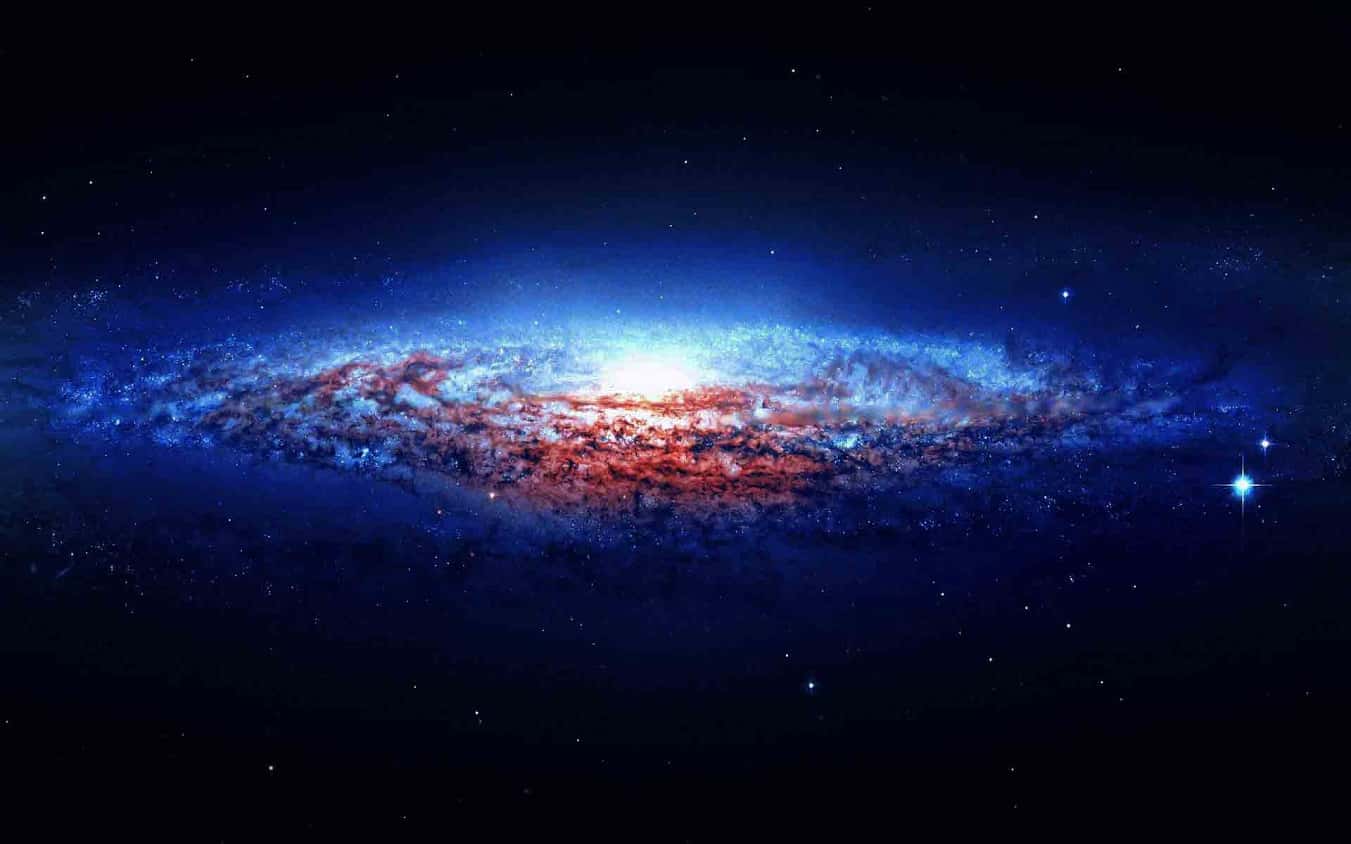
 Basically, the macrocosm is just an image, a mirror of the microcosm and vice versa. For example, atoms have similar structures to solar systems or planets. An atom has a nucleus around which electrons orbit. Galaxies have cores around which solar systems orbit. Solar systems have a sun at the center around which the planets revolve. Other galaxies border galaxies, other solar systems border solar systems. Just like in the microcosm in the atom follows the next. Of course, the distance from galaxy to galaxy seems gigantic to us. However, if you were the size of a galaxy, the distance for yourself would be as normal as the distance from house to house in a neighborhood. For example, the atomic distances seem very tiny to us. But from the point of view of a quark, atomic distances are just as huge as galactic distances are for us.
The outer world is a mirror of my inner world and vice versa!
The Law of Correspondence also has a powerful effect on our own reality, on our own awareness a. The way we feel inside is how we experience our outside world. Conversely, the outside world is just a mirror of our inner feelings. For example, if I feel bad, then I look at the outside world from this feeling. If I am firmly convinced that everyone is unkind to me, then I will carry this feeling outwardly and will also be confronted with a great deal of unkindness.
Since I'm then firmly convinced of it, I'm not looking for friendliness, but only unfriendliness (you only see what you want to see) in people. Your own attitude is decisive for the formative moments that happen to us in life. If I get up in the morning and think that the day will be bad, then I will only be confronted with bad events, since I myself assume that the day will be bad and will only see the bad in this day and its situations.
You are responsible for your own happiness!
 If I'm woken up early in the morning by a neighbor mowing the lawn, I can get upset and say to myself: "Not again, the day is starting great." Or I say to myself: "Now is the right time to get up, my fellow human beings are active and I now join them with euphoria: "If I feel bad or depressed and because of this I don't have the energy to keep my apartment in order, then my inner state is transferred to the outer world. The outer circumstances, the outer world then adapts to my inner world. After a relatively short time I will then be confronted with a self-initiated disorder. If I then ensure a pleasant environment again, it will also be noticeable in my inner world, where I will feel better.
So the change always begins within yourself. If I change myself, then my entire environment changes as well. Everything that exists, every situation that you create yourself, always arises first in your own conscious world of thoughts. For example, if you go shopping right away, then you only do it because of your mental imagination. You imagine going shopping right away and realize this scenario through active action, you manifest your own thoughts on a "material" level. We are responsible for our own happiness or bad luck (there is no path to happiness, because happiness is the way).
Every existence is a unique, infinite universe!
Everything that exists, every galaxy, every planet, every human, every animal and every plant is a unique, infinite universe. There are fascinating processes deep in the inner structures of the cosmos that are limitless in their diversity. In humans alone there are trillions of cells, billions of neurons and other innumerable microcosmic structures. The spectrum is so large and diverse that we ourselves represent a limitless universe within a universe surrounded by universes. This universal scheme can be transferred to everything and everyone, since everything emerges from the same energetic source.
Just yesterday I went for a walk through the forest. I thought about how many universes can be found here. I sat down on a tree trunk, looked into nature and saw countless creatures. Every animal, plant and spot was teeming with fascinating life. Whether insect or tree, both creatures radiated so much life and uniqueness that I was just struck and touched by the natural complexity. In this sense stay healthy, happy and live a life in harmony.